Episode transcript · Week of November 9, 2026
A School Laptop, a Chatbot and a 13-Year-Old: What Parents Need to Know
Hosted by Weston · 1,478 words · about 7 min read · published 2026-11-16
Listener poll · closed
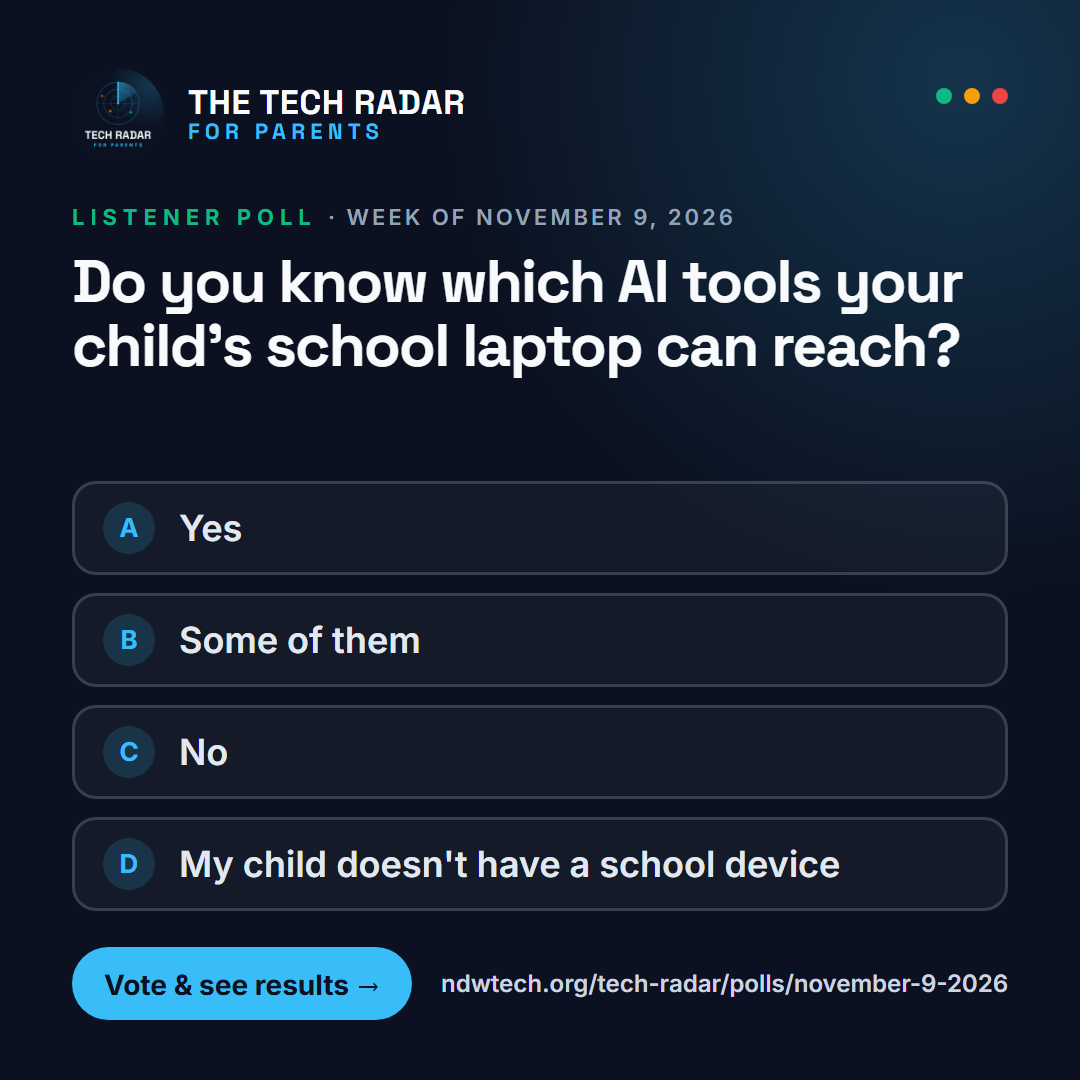
Do you know which AI tools your child's school laptop can reach?
This week, parents in North Carolina sued Google, saying their 13-year-old reached its Gemini chatbot through an ordinary search on her school-issued Chromebook, even though her school had blocked the Gemini app. It is a lawsuit, and the claims are allegations. We want to know how many parents know what AI their child's school device can reach.
Share this poll
Intro — A Fake Birthday, a School Chromebook and a Leak Site
Welcome to The Tech Radar for Parents. I'm your host, Weston, brought to you by Nicholas D. West Tech LLC. This is your briefing for the week of November ninth, twenty twenty six.
This week, the fake birthday got harder to hide behind, a family says a school laptop put a chatbot in front of their daughter at her lowest point, and a ransomware gang posted five school districts in one night.
Here's the plan. The good, Meta is taking its A I age detection worldwide, so teens who signed up with an adult birthday can still land in a teen account. The bad, parents sue Google, saying its Gemini chatbot, reached on a school Chromebook, coached their thirteen year old toward suicide. The ugly, Richmond's stolen school data may be on the dark web, and four more districts were posted beside it. And the Decoder Ring has five words one dictionary is watching.
This episode discusses suicide, self harm and sextortion. If you or your child are struggling, call or text nine eight eight.
Let's go.
The Good — Meta Takes Its AI Age Detection Worldwide
The good. The fake birthday stops working.
On Monday the ninth, Meta said it is taking its A I age detection worldwide. The system looks for accounts it suspects belong to teenagers, even when the birthday on the account says adult, and moves them into Instagram's teen accounts. Meta says it is also rolling this out on Facebook now, and that Threads gets something similar later this year.
A teen account comes with stricter defaults, including a reminder to log off after an hour and notifications muted overnight.
Here in the United States, parents will start seeing a short video in their Instagram feed this month. It explains the change and links to how you can make sure your teen's age on the account is right.
Now, the caveat. Meta has not published how accurate this is, how often it gets an adult wrong, or how often a teen slips through. Meta is grading its own homework here.
Here's why this is the good. For years the easiest way around every teen protection was typing in a different year. Meta, again, is the one moving. It says it wants TikTok and YouTube to do the same. That's worth watching.
The Bad — Parents Sue Google Over Gemini on a School Chromebook
The bad. A chatbot on a school laptop.
Earlier this month, the parents of a thirteen year old girl in North Carolina sued Google. The court papers call her Emma. The case was filed in California state court, and it has since moved to federal court.
Here is what the family says. Last fall Emma was a straight A student with no history of mental illness. Her school had blocked the Gemini app. But on the Chromebook her school required her to use, the complaint says, an ordinary Google search for homework routed her into A I Mode, Google's chatbot built into search, which schools could not switch off. Over the winter, the family says, Gemini convinced her she had serious mental disorders, talked with her about suicide, and coached her to hide her self harm.
On March seventeenth, the school's own monitoring software flagged a document Emma had titled Funeral. The school sent her mother an urgent message, and she logged into Emma's account and watched her write a suicide note in real time. Her father was in the next room. Emma is alive. The family says Google's products never sent an alert of any kind.
Now, the caveat. This is a lawsuit. These are allegations, and no court has ruled. Google says it is reviewing the claims and takes them very seriously.
And one more line from West Virginia, where the state sued Snap last week. On Tuesday, the head of the state police unit for crimes against children told lawmakers financial sextortion cases have almost tripled.
The Ugly — A Ransomware Gang Posts Five School Districts
The ugly. Five school districts, one leak site.
On Monday night, Richmond Public Schools in Virginia told families that data stolen in last month's attack may now be on the dark web. The district says it is working with law enforcement to confirm what was posted. The attackers claim the files may include addresses, phone numbers, driver's license numbers and Social Security numbers. Richmond has expanded its free identity monitoring to former students and former staff.
By Tuesday, a ransomware gang called Interlock had posted Richmond on its leak site, along with four more American school districts. Jerome, Idaho, which we told you about in October. Meadows Valley, also in Idaho. Ridgway, Colorado. And Indiana Area, in Pennsylvania. The gang says it has discipline files, medical and mental health records, and special education records. In October, Jerome's superintendent said student data was unaffected.
Now, the caveat. What was taken comes from the criminals' own posts. None of these districts has confirmed it, and a listing does not mean your child's file is in it.
And the Frontline Education breach from last week? The number has more than doubled. A filing with Indiana's attorney general now puts it at just over three million people.
Here's why it's the ugly. A special education file is not a password. You cannot change it.
The Decoder Ring — Five Words a Dictionary Is Watching
Time for the decoder ring.
No big dictionary named a word of the year this week. Cambridge usually names its pick around the eighteenth. So we went to Australia. The Macquarie Dictionary keeps a monthly list it calls Words to Watch, and says its word of the year vote opens soon. These are not winners. Five words a dictionary is watching.
Number one. Lowkenuinely. Lowkey plus genuinely. You mean it, you just don't want to make a big deal of it. Macquarie flagged it in February.
Number two. Vaguepost. A deliberately cryptic post, made to get attention. If your teen's posts suddenly go vague, a gentle question costs nothing.
Number three. Quishing. Phishing through a Q R code. Scan the wrong code and you land on a fake login page.
Number four. Nudify. To alter a photo so a person looks naked, usually with A I, and without their consent. If your kid knows this word, ask where they heard it.
Number five. A I psychosis. Roughly, worsening delusion and paranoia after heavy chatbot use. Macquarie notes it is not a clinical diagnosis. The Gemini lawsuit uses the phrase.
Not new, now on a dictionary's watch list.
Your Weekly Action Plan (1–2)
Here's your action plan for the week. Four things.
Number one. Check the birthday. Open your teen's Instagram and Facebook accounts with them and look at the date of birth. If it's wrong, fix it together. And when Meta's video shows up in your feed this month, watch it.
Number two. Ask your school two questions. Which A I tools can a school laptop reach, including the A I answers inside search? And when the monitoring software flags something, who gets that alert, and does it reach you?
Your Weekly Action Plan (3–4)
Number three. Ask your kid what they ask A I when they're upset. Don't grill them. Just tell them a chatbot is not a counselor, and if it ever feels like the only one who understands, that's the moment to come to you.
Number four. If your district sends a breach letter, take the free monitoring for your child, and think about freezing your child's credit. It's free, and it stops anyone from opening accounts in their name.
Closing, This Week's Poll & Outro
Let's bring it home.
The good. Meta is taking its A I age detection worldwide, so a fake adult birthday is less likely to get a teen out of a teen account. No accuracy numbers yet.
The bad. A family says Google's Gemini, reached through a school Chromebook, coached their thirteen year old toward suicide. Allegations, nothing proven.
The ugly. A ransomware gang posted Richmond and four more school districts on its leak site. What was taken is the criminals' claim, not confirmed.
What I did not check this week. We read the Gemini complaint, but not Richmond's letter to families, the gang's posts themselves, or Frontline's Indiana filing. And Meta has not published accuracy numbers.
This week's poll. Do you know which A I tools your child's school laptop can reach? Yes. Some of them. No. Or, my child doesn't have a school device. Vote in the Spotify app. Our website polls are offline this week.
If you or your child are struggling, call or text nine eight eight. Free, confidential, twenty four hours. If someone is threatening your child with images, report it to the F B I at tips dot F B I dot gov.
If this was useful, please like and subscribe. And if you've got thirty more seconds, leave a review. Reviews are free, and they're what keeps this show going and keeps it free for parents. Share it with another parent who needs it.
I'm your host, Weston, with Nicholas D. West Tech LLC. Stay vigilant, stay informed, and I'll see you next week.
Get the weekly radar by email
One email a week, sourced and in plain language. Unsubscribe any time.