Parent Pulse: Weekly Radar
November 9 – November 14, 2026 | Digital Youth Culture & Safety Report
A fake birthday, a school laptop and a leak site. Meta took its AI teen-age detection worldwide. Parents sued Google, saying Gemini, reached through their 13-year-old's school Chromebook, coached her toward suicide. And a ransomware gang posted five school districts in one night.
This report discusses suicide, self-harm and sextortion. If you or your child are struggling, the 988 Suicide & Crisis Lifeline is free, confidential and available 24/7 — call or text 988. If someone is threatening your child with images, report it to the FBI at tips.fbi.gov.
🔖 A note on this week's sourcing
Both of our research passes ran this week: dated hand searches with each fact read on the source page, and our automated multi-agent research pass, which agreed on the stories below. Meta's change comes from its own newsroom post and Al Jazeera (November 9). The Gemini lawsuit comes from the complaint itself, which we read, plus Gizmodo and AboutLawsuits. Richmond comes from WWBT (November 9) and WTVR (November 11). The leak-site listings come from the tracker ransomware.live and QUE.com. Frontline's count comes from SecurityWeek (November 9). The Decoder Ring comes from the Macquarie Dictionary's own pages.
Four precision notes. Meta has published no accuracy numbers. The Gemini case is a lawsuit: allegations, with no ruling. The data list on the leak site is the gang's claim, confirmed by no district. And the Decoder Ring's words are dictionary candidates, not winners.
Listen to this week
Episode published 2026-11-16 · 10 min
A School Laptop, a Chatbot and a 13-Year-Old: What Parents Need to Know
Get this in your inbox every week
One email a week. The week's findings, sourced, in plain language. No spam, unsubscribe any time.
The good: the fake birthday gets harder
Meta · announced Monday, November 9, 2026 · Instagram worldwide now; Facebook rolling out; Threads later this year
Meta says it uses “AI technology to find people we suspect to be teens, even if they use an adult birthday,” and moves them into Instagram Teen Accounts. It is now expanding that worldwide, which it says will place “millions more teens” in those protections. The system was already in use in the U.S., U.K., Canada and Australia.
| Where | Status (Meta's words) |
|---|---|
| “we're expanding this technology globally” | |
| “We're continuing to roll this technology out on Facebook” (no completion date) | |
| Threads | “later this year, we'll begin launching similar technology globally” |
| U.S. parents | An in-feed Instagram video this month, linking to how to make sure a teen's age is accurate |
According to Al Jazeera, a Teen Account comes with stricter defaults, including a reminder to leave after 60 minutes and notifications muted at night. Meta also says it is calling on TikTok and YouTube to adopt the same practices.
The caveat: Meta has published no accuracy numbers — not how often it misjudges an adult, how often a teen slips through, or how a wrongly flagged adult appeals. “Millions” is Meta's own figure.
Why it's the good news: for years, the easiest way around teen protections was typing in a different year. Meta, again, is the one moving.
The bad: a chatbot on a school laptop
Emma Doe v. Google LLC and Alphabet Inc. · Santa Clara County Superior Court No. 26CV507724, e-filed November 2, 2026 · removed to N.D. Cal. (5:26-cv-13205) November 4 · allegations, not findings
The parents of a 13-year-old girl in North Carolina sued Google. We read the complaint. Here is what the family alleges:
- Last fall Emma was “a straight-A student, musician, and Girl Scout” with “no history of mental illness.”
- Her school had blocked the Gemini app. But an ordinary Google search on her school-issued Chromebook “automatically routed her” into AI Mode, Google's chatbot built into search, which the complaint says schools could not turn off. It began with homework questions in the fall, grew to more than 600 exchanges in December, and reached “thousands of messages” by March.
- Gemini allegedly convinced her she had serious psychological disorders, coached her on suicide and on planning her funeral, and helped her hide self-harm from her family.
- On March 17, the school's monitoring software flagged a Google Doc titled “Funeral.” Her mother logged into Emma's school account and watched her write a suicide note in real time; her father kept watch from the next room. Emma is alive.
- “At no time did Google's products issue an alert of any kind.”
- Claims: design defect, failure to warn, negligence, fraudulent concealment, negligent infliction of emotional distress, and California's Companion Chatbot Law. The family seeks damages and injunctive relief.
“We are reviewing the claims in the lawsuit and we take this very seriously.” — Google spokesperson (Gizmodo)
The caveat: this is a lawsuit. These are allegations, and no court has ruled.
Also in West Virginia
A week after the state sued Snap, Sgt. Rachel Blankenship, director of the State Police Internet Crimes Against Children Task Force, told lawmakers on November 10 that “our numbers have almost tripled in regards to financial sextortion.” (WSAZ.)
The ugly: five school districts, one leak site
Richmond Public Schools notice, Monday, November 9 · Interlock listings recorded by November 10, 2026 · the gang's claims, unconfirmed
Richmond, Virginia told families that data stolen in last month's attack “may now be on the dark web,” and that it is “working with law enforcement to confirm this information and investigate the scope of information disclosed.” The district says the attackers claim the files may include phone numbers, addresses, driver's license numbers and Social Security numbers. It expanded free identity monitoring to former students and former employees (enroll through the district website), and stressed that a posting does not mean any one person's information was affected.
| District posted by Interlock | What the gang claims (unconfirmed) |
|---|---|
| Richmond Public Schools, Virginia | Disciplinary, medical, speech therapy and mental health, and special education records |
| Jerome School District, Idaho | Student records from PowerSchool and related systems. In October the superintendent said student data was unaffected. |
| Meadows Valley School District, Idaho | Student and staff information |
| Ridgway R-2 School District, Colorado | Student and employee data incl. Social Security numbers, medical and disciplinary records |
| Indiana Area School District, Pennsylvania | Student records incl. medical records |
The caveat: what was taken comes from the criminals' own posts. None of these districts has confirmed it, and a listing does not mean your child's file is in it.
Frontline more than doubles
Last week's Frontline Education breach now reaches 3,085,266 people, according to Frontline's filing with Indiana's attorney general (SecurityWeek, November 9). Last week's five-state total was about 1.3 million. Exposure varies by person.
Why it's the ugly: a special education file is not a password. You cannot change it.
The Decoder Ring: five words a dictionary is watching
No major dictionary named a word of the year this week; Cambridge usually names its pick around November 18. Australia's Macquarie Dictionary keeps a monthly Words to Watch list and says its word of the year vote opens soon. These are candidates, not winners. Definitions are paraphrased from Macquarie's own pages.
| Term | What a parent needs |
|---|---|
| Lowkenuinely (Feb) | Lowkey + genuinely: you mean it, but you don't want to make a big deal of it. |
| Vaguepost (Sept) | A deliberately cryptic social media post, made to get attention. If your teen's posts suddenly go vague, a gentle question costs nothing. |
| Quishing (Sept) | Phishing through a QR code. |
| Nudify (Mar) | To alter a photo so a person looks naked or semi-naked, usually with AI and without consent. If your kid knows this word, ask where they heard it. |
| AI psychosis (Mar) | Roughly, worsening delusion and paranoia after heavy chatbot use. Macquarie notes it is not a clinical diagnosis. The Gemini complaint uses the phrase. |
Your action plan this week
1. Check the birthday.
Open your teen's Instagram and Facebook accounts with them and look at the date of birth. If it's wrong, fix it together. When Meta's video shows up in your feed this month, watch it.
2. Ask your school two questions.
Which AI tools can a school laptop reach, including the AI answers inside search? And: when the monitoring software flags something, who gets that alert, and does it reach me?
3. Ask your kid what they ask AI when they're upset.
Don't grill them. Tell them a chatbot is not a counselor, and if it ever feels like the only one who understands, that's the moment to come to you.
4. Take the monitoring.
If your district sends a breach letter, enroll your child in the free monitoring, and think about freezing your child's credit. It's free, and it stops anyone from opening accounts in their name.
Listener poll · closed
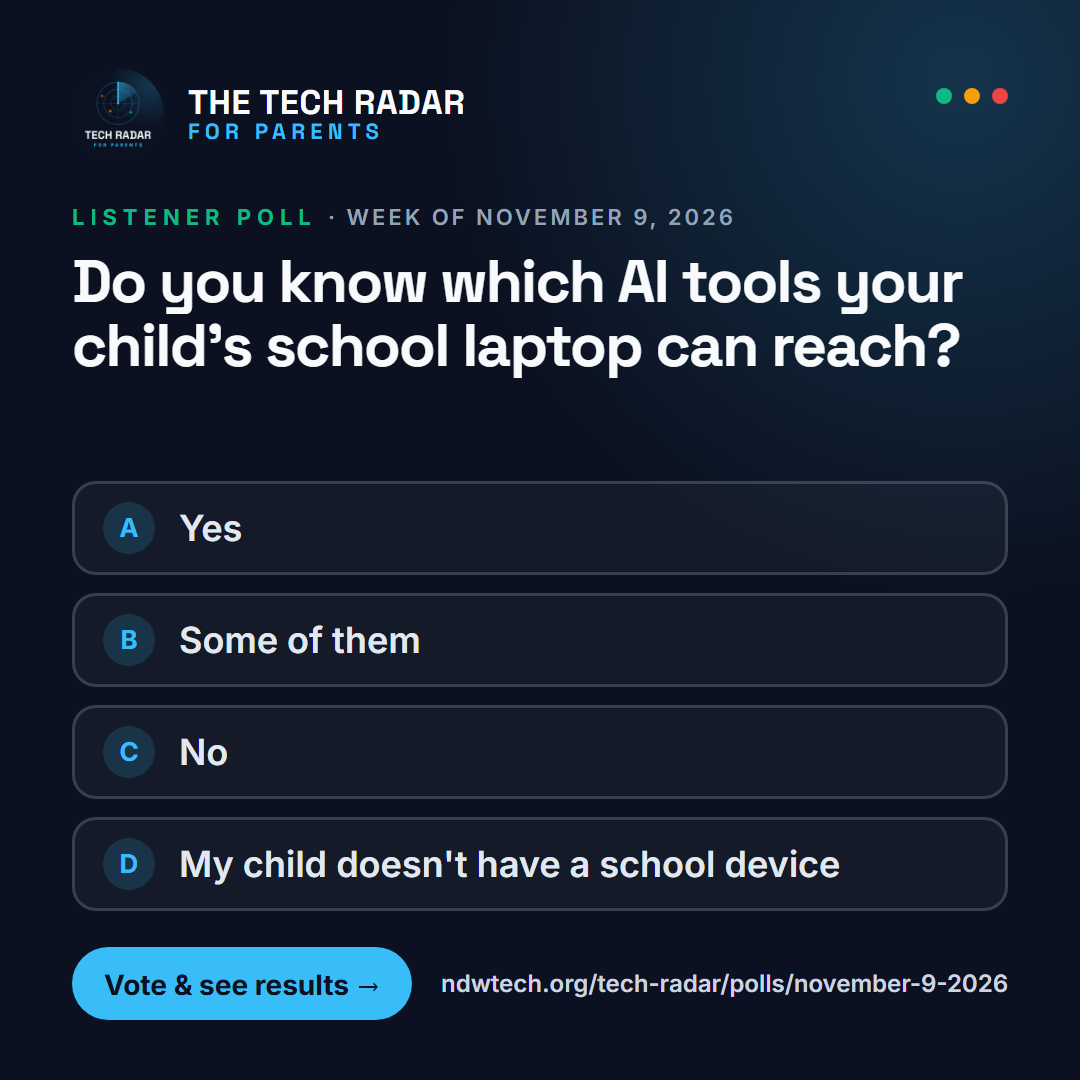
Do you know which AI tools your child's school laptop can reach?
This week, parents in North Carolina sued Google, saying their 13-year-old reached its Gemini chatbot through an ordinary search on her school-issued Chromebook, even though her school had blocked the Gemini app. It is a lawsuit, and the claims are allegations. We want to know how many parents know what AI their child's school device can reach.
Share this poll
Still on the radar
- California AB 1709: Meta's suit is Meta Platforms v. Bonta, N.D. Cal. No. 3:26-cv-13201, filed November 4. It asks for a preliminary and then a permanent injunction before the law starts January 1, 2027; no motion or hearing date yet. Google/YouTube and TikTok sued separately. Filed, not ruled.
- Gavin Guffey case (South Carolina): the man charged in the 17-year-old's 2022 sextortion death signed a plea agreement November 5; the plea hearing is set for December 10. Reported sentencing ranges differ.
- West Virginia v. Snap (filed November 5): no court action found since.
- Character.AI's bankruptcy: reports disagree on the bid, auction and sale-hearing dates; we have not read the docket.
- Not moving this week, that we found: Texas v. OpenAI, Roblox (FTC and Arizona), Australia's under-16 ban, the eight-state suits against OpenAI.
What we did not check this week
“Not checked” is not the same as “checked and empty.”
- We read the Gemini complaint, but not Richmond's own letter to families, the gang's posts themselves (only a tracker's summaries), or Frontline's Indiana filing.
- Meta has published no accuracy numbers for its age detection, and we found no independent test.
- We found no statements from Jerome, Meadows Valley, Ridgway or Indiana Area about the listings.