Episode transcript · Week of November 16, 2026
Meta's Plan to Put Instagram in Your Kid's School, and Why It Worries Parents
Hosted by Weston · 1,524 words · about 8 min read · published 2026-11-23
Listener poll · closed
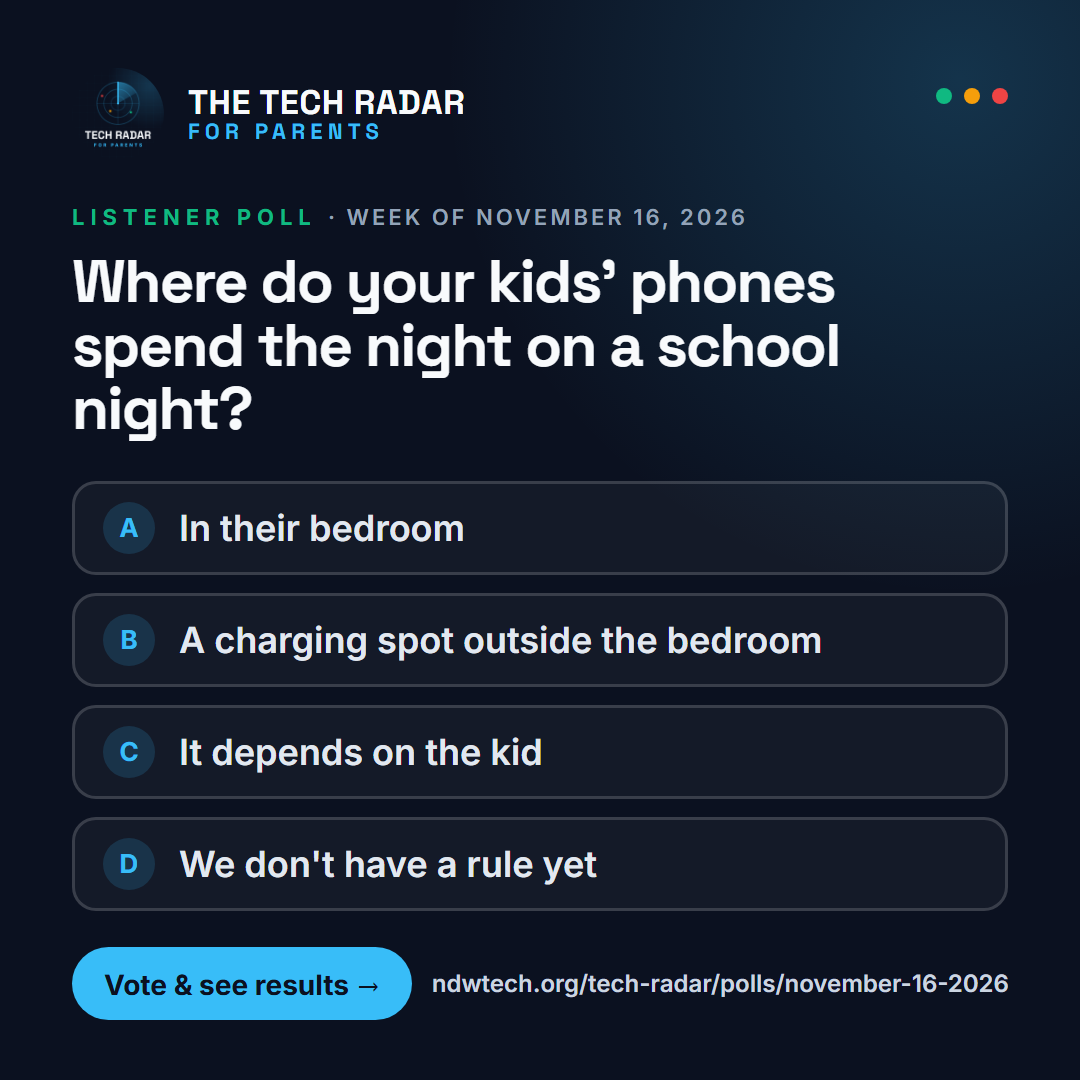
Where do your kids' phones spend the night on a school night?
This week, a Harvard study found strict school phone bans add a small amount of learning each year, and the lead author said late-night phone use outside school may matter even more. Every family handles the night differently. We want to know what parents do at home. There is no right answer.
Share this poll
Intro — Phone Pouches, Project Gryffindor and 160 a Day
Welcome to The Tech Radar for Parents. I'm your host, Weston, brought to you by Nicholas D. West Tech LLC. This is your briefing for the week of November sixteenth, twenty twenty six.
This week, locking the phones away at school finally has some numbers behind it, Meta's own documents show why it wanted Instagram inside your child's school, and a new investigation says sextortion now reaches more than a hundred and sixty children a day.
Here's the plan. The good, a Harvard study finds strict school phone bans add a little learning every year. The bad, N P R reports that Meta's school program for Instagram was also a plan to sign up more teens. The ugly, the Associated Press and FRONTLINE on the sextortion scam, and the safety features that did not stop it. And the Decoder Ring has a dictionary's word of the year, plus two words your teen already knows.
This episode discusses suicide and sextortion. If you or your child are struggling, call or text nine eight eight.
Let's go.
The Good — Strict School Phone Bans Add a Little Learning
The good. The phones went in the pouch, and the scores moved.
On Tuesday the seventeenth, researchers at Harvard, working with Dartmouth and the testing company N W E A, put out one of the biggest studies yet of school phone bans. They looked at test scores for about three point three million students in about forty six hundred schools, over five school years.
What they found. In schools with a strict ban, meaning phones locked in a pouch, stored in a central spot, or kept off campus, students gained the equivalent of one to two extra weeks of instruction a year. The lead author, Thomas Kane, says that is about half of what American students have been losing each year since twenty thirteen.
The key, he says, is that a strict ban doesn't depend on every teacher enforcing it, and it doesn't leave the phone in a backpack half a second away.
Now, the caveat. The effect is small. One to two weeks a year is not a cure, and an earlier national study from Stanford found close to no effect at all.
Here's why it's the good. Parents have been arguing about phone bans on gut feeling. Now there is real evidence that the strict kind helps a little, and that the help may add up.
The Bad — Meta's Project Gryffindor Put Instagram in Schools
The bad. Project Gryffindor.
On Wednesday the eighteenth, N P R reported on internal Meta documents about Instagram's school partnership program. Publicly, Meta calls it a safety tool. Schools sign up, staff can report bullying faster, and verified students can add a school badge or a school banner to their profile and browse a directory of other students at their school. Meta said in September that almost seventeen thousand schools had joined.
Inside the company, N P R reports, the project had a code name, Gryffindor, and a twenty twenty four presentation listed its goals as acquisition, friending, and invites. In other words, more teens on Instagram. A legal brief filed for school districts describes push notifications aimed at the students of one school at a time, to tip that school from inactive to active.
Here is the part that worries safety experts. One investigator told N P R that finding out where a teen goes to school is written into the script sextortion scammers use, and that a school directory is a sextortionist's dream.
Now, the caveat. These are internal documents that came out in a lawsuit, as reported by N P R. Meta says the story completely mischaracterizes a positive program, and no court has ruled on any of it.
Here's why it's the bad. A school badge tells a stranger exactly where to find your child, and the next story shows why that matters.
The Ugly — Sextortion Reaches 160 Children a Day
The ugly. A hundred and sixty a day.
On Tuesday the seventeenth, the Associated Press and P B S FRONTLINE published an investigation into financial sextortion. That is the scam where someone poses as a teen, gets a nude photo, then demands money or they'll send it to everyone the child knows. The investigation says more than a hundred and sixty children were hit by it every day this year.
The National Center for Missing and Exploited Children says these cases rose nearly forty percent last year, and that at least thirty six teenage boys in this country have died by suicide after being targeted since twenty twenty one.
Then the safety features. Researchers at N Y U and Northeastern found about sixty percent of the online safety features they tested did not work as intended. One investigator set up a fake Instagram account posing as a teenage boy. Within two weeks, four suspected sextortionists had reached out. His words: the new safety feature was not effective in any of our tests.
Now, the caveat. The hundred and sixty a day is the A P's figure, and the pages we read don't show how it was calculated. Meta calls the safety research fundamentally flawed.
Here's why it's the ugly. The advice from every expert is the same. If a child pays, the threats keep coming. They need to know they can come to you instead.
The Decoder Ring — Cambridge Picks Human, Plus Aura Farming
Time for the decoder ring.
This week Cambridge Dictionary named its word of the year, and it's one you already know. Human. Cambridge says this was a year of arguing about what it means to be human while A I blurs the line between people and machines. You'll hear it in phrases like human made.
Cambridge also added new words this year, and two of them come straight from your teen's feed. Newly official, not new.
Number one. Aura farming. Roughly, doing things on purpose to look effortlessly cool. The slow walk, the calm face, the perfectly timed post. Mostly harmless, and sometimes funny.
Number two. Looksmaxxing. We've covered this one before, and now Cambridge has it too. Making yourself as attractive as possible, pushed mostly at young men on social media. If your son is talking about his jawline, ask where he's hearing it.
And a bonus. Oxford has a shortlist out, and the vote closes Tuesday the twenty fourth. One candidate is slopaganda, slop plus propaganda, meaning cheap A I made content pushing a message. Another is microdrama, those tiny vertical soap operas made for phones. These are candidates, not winners.
Your Weekly Action Plan (1–2)
Here's your action plan for the week. Four things.
Number one. Ask your school one question. Did you sign up for Instagram's school partnership program? Then sit down with your teen and look at their Instagram profile together. If there's a school badge or a school banner on it, talk about who can see it.
Number two. Teach the script. A new online friend who asks early where you go to school is a red flag. And if anyone ever threatens your child with a picture, the rule is don't pay, stop replying, and come to us. Report it to the CyberTipline at the National Center for Missing and Exploited Children, and use their free Take It Down tool to get images pulled.
Your Weekly Action Plan (3–4)
Number three. Ask where the phones actually go during the school day. A locked pouch, a locker, a backpack, or a pocket. The Harvard study says the strict kind is the kind that helped.
Number four. Decide where phones sleep. The study's author thinks late night scrolling may matter even more than phones at school. That one is up to you, not the school.
Closing, This Week's Poll & Outro
Let's bring it home.
The good. A Harvard study finds strict school phone bans add one to two weeks of learning a year. Small, but real.
The bad. N P R reports Meta's school program for Instagram was also a plan to sign up more teens. Internal documents, and Meta disputes the story.
The ugly. The A P and FRONTLINE say sextortion reaches more than a hundred and sixty children a day, and most of the safety features tested didn't hold up. Meta calls that research flawed.
What I did not check this week. We did not read the Harvard paper itself, the full A P investigation, or the research behind that sixty percent. And we don't know which schools joined Instagram's program. That's why you ask.
This week's poll. Where do your kids' phones spend the night on a school night? In their bedroom. A charging spot outside the bedroom. It depends on the kid. Or, we don't have a rule yet. Vote in the Spotify app. Our website polls are still offline this week.
If you or your child are struggling, call or text nine eight eight. Free, confidential, twenty four hours. If someone is threatening your child with images, report it to the F B I at tips dot F B I dot gov.
If this was useful, please like and subscribe. And if you've got thirty more seconds, leave a review. Reviews are free, and they're what keeps this show going and keeps it free for parents. Share it with another parent who needs it.
I'm your host, Weston, with Nicholas D. West Tech LLC. Stay vigilant, stay informed, and I'll see you next week.
Get the weekly radar by email
One email a week, sourced and in plain language. Unsubscribe any time.