Parent Pulse: Weekly Radar
November 16 – November 21, 2026 | Digital Youth Culture & Safety Report
Phone pouches, Project Gryffindor and 160 children a day. Locking phones away at school finally got some numbers behind it, Meta's own documents showed why it wanted Instagram inside your child's school, and a new investigation said sextortion now reaches more than 160 children a day.
This report discusses suicide and sextortion. If you or your child are struggling, the 988 Suicide & Crisis Lifeline is free, confidential and available 24/7 — call or text 988. If someone is threatening your child with images, report it to the FBI at tips.fbi.gov or to NCMEC's CyberTipline, and use Take It Down to get images removed.
🔖 A note on this week's sourcing
Both of our research passes ran this week, and this time they disagreed. Our automated multi-agent pass never surfaced the three stories below, all of which broke on November 17 and 18; our dated hand searches did, and we read each fact on a fetched page. The phone-ban study comes from the Harvard Gazette's interview with its lead author and from Chalkbeat (Harvard's own page blocked us). Project Gryffindor comes from NPR's November 18 report, which we read in full. The sextortion figures come from the Associated Press's takeaways and a syndicated AP/FRONTLINE summary. The Decoder Ring comes from CNN's report of Cambridge Dictionary's statement and secondary coverage of Oxford's shortlist.
Four precision notes. The phone-ban effect is small. Project Gryffindor is internal documents from a lawsuit, and Meta disputes the story. The 160-a-day figure is AP's, and the pages we read do not show how it was calculated. Oxford's words are a shortlist, not winners.
Listen to this week
Episode published 2026-11-23 · 10 min
Meta's Plan to Put Instagram in Your Kid's School, and Why It Worries Parents
Get this in your inbox every week
One email a week. The week's findings, sourced, in plain language. No spam, unsubscribe any time.
The good: phones in the pouch
Harvard Center for Education Policy Research, with NWEA and Dartmouth · released Tuesday, November 17, 2026 · a small effect
Researchers looked at NWEA MAP Growth scores for about 3.3 million students in about 4,600 schools, from 2021-22 through 2025-26. They compared schools before and after they adopted a strict phone ban.
| Question | What the study found |
|---|---|
| What counts as strict | Phones locked in a pouch, stored in a central spot, or kept off campus |
| The effect | About 0.01 standard deviations a year: “equivalent to between a week and two weeks of additional instruction over the course of a year” |
| In context | About half the size of the small yearly losses since 2013 (the paper's “slow leak”) |
| Who it helped | Low scorers did not get a bigger boost; a group of students with big in-year reading losses saw those losses stop |
“The key idea is that you're not relying on teachers to enforce it ... And you're not tempting students with having the phone in their backpack.” — Thomas Kane, Harvard (Harvard Gazette)
Kane also thinks phone use outside school, including late-night binges, may matter more for some students, and an in-school ban “won't take that effect away.”
The caveat: the effect is small. An earlier national study led by Stanford's Thomas Dee found close to no effect on test scores; Dee calls the new numbers “really small, sensitive estimates.” States that banned phones were already on different paths beforehand, so the state-level results are hard to read.
Why it's the good news: the phone-ban argument has run on gut feeling. Now there is real evidence that the strict kind helps a little, and that the help may add up.
The bad: Project Gryffindor
NPR · Wednesday, November 18, 2026 · internal Meta documents from the federal social media lawsuit · Meta disputes the story
Instagram's school partnership program launched in 2025 and expanded in September 2026, when Meta said almost 17,000 schools had signed up. Verified students can add a school badge or school banner to their profile and browse a directory of other students at their school. Meta says it lets educators report bullying and safety problems quickly.
- A 2024 internal presentation on “Project Gryffindor” named user “acquisition,” “friending” and “invites” as goals.
- A 2023 presentation said the program would “give teens a new reason to join / find more value in IG.”
- A 2025 legal brief filed for school districts describes “school blasts,” push notifications aimed at one school's students at a time.
- Cybersecurity investigator Paul Raffile told NPR that where a victim goes to school is “actually written into the script that the scammers use,” and that a school directory is “a sextortionist's dream.”
“This story completely mischaracterizes a positive program that helps thousands of U.S. schools protect their students online, communicate with them safely about extracurricular activities, and easily report safety issues.” — Liza Crenshaw, Meta spokesperson (NPR)
The caveat: these are internal documents that surfaced in a lawsuit, as reported by NPR. Meta disputes the story, and no court has ruled. We found no public list of which schools joined.
The ugly: 160 children a day
Associated Press and PBS FRONTLINE · published Tuesday, November 17, 2026
Financial sextortion is the scam where someone poses as a teen, gets a nude photo, then demands money or threatens to send it to everyone the child knows.
| Finding | Source |
|---|---|
| More than 160 children a day affected in 2026 | AP / FRONTLINE |
| Cases rose nearly 40% in 2025 | NCMEC |
| At least 36 U.S. teen boys died by suicide after sextortion since 2021 | NCMEC |
| About 60% of tested safety features did not work as intended (Meta calls the research “fundamentally flawed”) | NYU and Northeastern researchers |
| A decoy Instagram account posing as a teen boy drew four suspected sextortionists in two weeks | Investigator Paul Raffile |
What experts say to do: don't pay; cut off contact; tell a trusted adult; report to NCMEC's CyberTipline. “If kids pay, the threats inevitably continue,” said Lindsay Lobb of the Canadian Centre for Child Protection. Fewer than one in ten financially sextorted young people said their images were actually shared.
The caveat: the 160-a-day figure is AP's, and the pages we read do not show how it was calculated. Meta calls the safety-feature research fundamentally flawed.
Why it's the ugly: if a child pays, the threats keep coming. They need to know, before it happens, that they can come to you instead.
The Decoder Ring: a word of the year, and two words your teen already knows
Cambridge Dictionary's 2026 Word of the Year is “human”, defined as “having the qualities, faults, and feelings that people have, as opposed to gods, animals, or machines.” Cambridge says the year was defined by debates over what it means to be human as AI blurs the line between people and machines. It is a word of the year, not slang. Cambridge also added new words this year: newly official, not new.
| Term | What a parent needs |
|---|---|
| Aura farming (Cambridge, new) | Roughly, doing things on purpose to look effortlessly cool. Mostly harmless. |
| Looksmaxxing (Cambridge, new) | Making yourself as physically attractive as possible, pushed mostly at young men on social media. We covered it when Merriam-Webster added it. If your son is suddenly talking about his jawline, ask where he's hearing it. |
| Slopaganda (Oxford shortlist) | Slop plus propaganda: low-quality AI-made content pushing a message. |
| Microdrama (Oxford shortlist) | Very short vertical drama series made for phones. |
Oxford's shortlist also includes doomerism and post-literate. Its public vote closes November 24. These are candidates, not winners. Oxford's own page was not read.
Your action plan this week
1. Ask your school one question.
Did you sign up for Instagram's school partnership program? Then look at your teen's Instagram profile together. If there's a school badge or banner, talk about who can see it.
2. Teach the script.
A new online friend who asks early where you go to school is a red flag. If anyone threatens your child with a picture: don't pay, stop replying, and come to you. Report to NCMEC's CyberTipline, and use Take It Down to get images removed.
3. Ask where the phones go.
During the school day: a locked pouch, a locker, a backpack or a pocket? The strict kind is the kind that helped.
4. Decide where phones sleep.
The study's author thinks late-night scrolling may matter even more than phones at school. That rule is yours to set.
Listener poll · closed
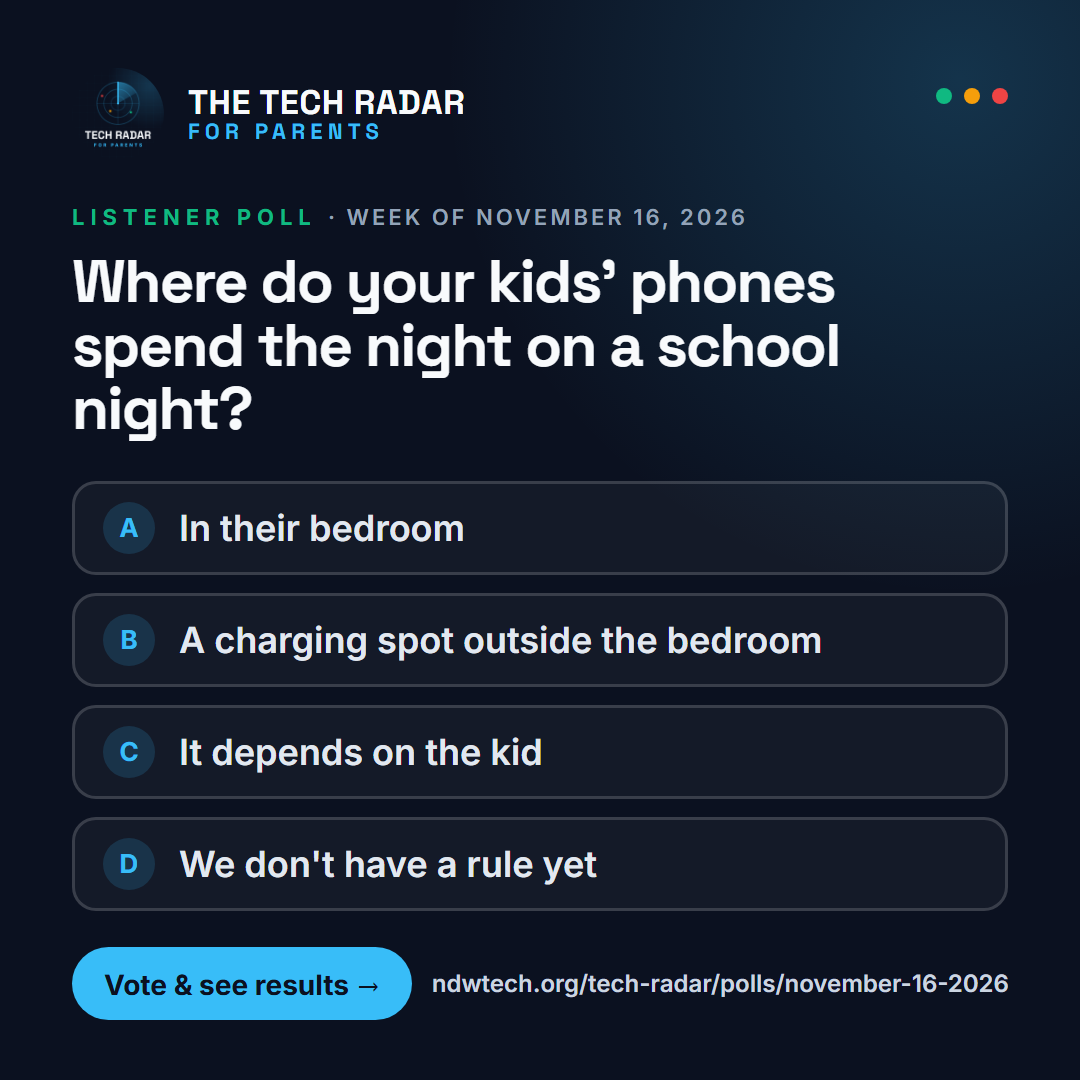
Where do your kids' phones spend the night on a school night?
This week, a Harvard study found strict school phone bans add a small amount of learning each year, and the lead author said late-night phone use outside school may matter even more. Every family handles the night differently. We want to know what parents do at home. There is no right answer.
Share this poll
Still on the radar
- Oregon v. OpenAI (filed November 17): alleges OpenAI “often fails to confirm that a parent signed off” for 13-year-olds, that ChatGPT for Teens safeguards are “easily bypassed,” and that the teen version did not alert parents to questions about suicide or self-harm. Seeks at least $2.035 billion. Allegations; filed, not ruled.
- Wisconsin v. TikTok (filed November 18, Dane County): targets infinite scroll, autoplay, push notifications and TikTok LIVE. TikTok says it will “vigorously defend.”
- Woods Charter School, North Carolina: the school says a juvenile used AI to make nude images from 47 student and 14 staff photos. No charge as of November 19.
- Wilmington School District 209-U, Illinois: a ransomware attack on November 17 that “may have involved a data breach.” Nothing confirmed. A ransomware gang separately listed Evergreen Park Elementary School District 124, Illinois, on November 17; that is the gang's claim.
- Mississippi: a federal appeals court lifted an injunction against the state's age-check law on November 19. Procedural; the law's constitutionality was not decided.
- Roblox: its CEO declined to testify at a Senate hearing on November 17, as senators introduced a bill to end forced arbitration for child exploitation victims. Introduced, not passed.
- Character.AI's bankruptcy: bids are due November 24, with a sale hearing December 3-4. State attorneys general asked for a privacy review of one bid.
- Gavin Guffey case: plea hearing still set for December 10.
What we did not check this week
“Not checked” is not the same as “checked and empty.”
- We did not read the Harvard paper itself; its page blocked us.
- We did not read AP's full investigation or the NYU and Northeastern research behind the 60% figure.
- We don't know which schools joined Instagram's program, and NPR does not say whether parents are told.
- We did not read Oxford's own shortlist page, or the Oregon and Wisconsin complaints.