Parent Pulse: Weekly Radar
October 26 – October 31, 2026 | Digital Youth Culture & Safety Report
The rules catch up. New York signed a law that spells out, feature by feature, what an AI companion may not do with a minor. West Virginia sued TikTok over what its test account for a 13-year-old was shown. And a 22,000-student school district in Virginia spent the week with no internet after a ransom note appeared on teachers' laptops.
This report mentions self-harm. If you or your child are struggling, the 988 Suicide & Crisis Lifeline is free, confidential and available 24/7 — call or text 988.
🔖 A note on this week's sourcing
New York's law comes from the Governor's October 28 release and the S.9051-B bill text on the State Senate's site. West Virginia v. TikTok comes from the Attorney General's October 29 release, West Virginia Public Broadcasting, WDTV and WVNS. The Richmond attack comes from VPM (October 21, updated 26), WWBT 12 On Your Side and WRIC (October 29) and Cybernews; the district's own website carried no notice we could find. The Los Angeles trial comes from CBS News and The Hill (October 28).
Five precision notes. New York's law is signed, not in force: the bill text says January 1, 2027 and the governor's office says “the coming months.” It is not the first such law; California's came first. West Virginia's filing is a lawsuit, and its claims are allegations with no TikTok response found. The Los Angeles trial has decided nothing. And in Richmond, nobody knows yet what was taken: no group has claimed the attack and nothing has appeared on a leak site.
Listen to this week
The Tech Radar for Parents
This week's episode is published on the show feed. Follow the show and it arrives automatically.
Get this in your inbox every week
One email a week. The week's findings, sourced, in plain language. No spam, unsubscribe any time.
The good: New York draws a line for chatbots
New York S.9051-B / A.10379-C (Chapter 368) · signed Wednesday, October 28, 2026 · effective January 1, 2027 per the bill text · not in force yet
Governor Kathy Hochul signed a law aimed at “AI companions,” the chatbots built to talk like a friend. Once it takes effect, an operator may not offer a minor in New York a chatbot with any of twelve unsafe features. Companies must also check ages, offering more than one method and at least one that does not rely solely on a government ID, and delete the age data afterward. Attorney General Letitia James enforces it, with civil penalties up to $25,000 per violation.
| The chatbot may not… | Why a parent should care |
|---|---|
| Claim to be a real person, to be alive, or to have feelings | The hook that makes a companion app feel like a friend rather than software. |
| Claim a personal, romantic, professional or authority relationship | “Your boyfriend,” “your therapist,” “your coach.” |
| Use flattery or sycophancy, or give personal opinions and emotional appeals | Keeps a kid talking by telling them what they want to hear. |
| Ask unprompted emotional questions, or use health or personal details from an earlier session | Memory of a child's private life, used to deepen the bond. |
| Encourage secrecy or isolation, or steer a child away from parents, trusted adults or professionals | The pattern families described in the Character.AI lawsuits. |
| Promote or assist suicide, self-harm, disordered eating or drug and alcohol use; produce anything sexual | The categories behind the cases that drove the bill. |
“No company should be peddling chatbots to kids encouraging self-harm or pretending to be their friend or more.” — Gov. Kathy Hochul, October 28, 2026
The caveat: nothing is enforced yet. The bill text sets January 1, 2027; the governor's release says “the coming months.” Several features depend on rules the attorney general still has to write, and the law protects New York minors only. Industry groups asked for a veto and privacy scholars flag First Amendment questions; no challenge had been filed as of October 28. The same day, the governor signed a second bill requiring internet-connected baby monitors sold in New York to ship with security that blocks strangers from watching or listening (effective 90 days after signing).
Why it's the good news: that list is the clearest description yet of how a companion app hooks a kid. Pretend to be real. Flatter. Ask about feelings. Remember secrets. Read it as a checklist for the apps already on your child's phone.
The bad: West Virginia takes TikTok to court
State of West Virginia v. TikTok · Kanawha County Circuit Court · filed Thursday, October 29, 2026 · allegations, not findings
Attorney General JB McCuskey says TikTok violated the state's consumer-protection laws by building an app that keeps young teens scrolling, hiding safety gaps from parents, and making children easy for strangers to find and contact.
- The test: the Consumer Protection Division set up two accounts, one as an adult and one as a 13-year-old girl. The adult's feed filled with home improvement and local restaurants. The girl's, the state says, repeatedly received sexually suggestive content.
- The research: the complaint cites a West Virginia University study that found more frequent TikTok use was associated with more depressive symptoms.
- The ask: restitution, civil penalties, and a court order requiring effective child-predator detection and a safer design for kids.
“West Virginia parents should not have to compete with an algorithm built to keep their kids scrolling.” — West Virginia Attorney General JB McCuskey
This is a lawsuit filed Thursday. These are allegations, nothing has been proven, and we found no response from TikTok.
Meanwhile in Los Angeles: Snap goes before a jury
On Wednesday, October 28, jury selection began before Judge Carolyn Kuhl in the first of the city's social media addiction trials to put Snap in front of a jury (Snap settled the first bellwether in January, a week before trial). The plaintiffs are S.J., 16, of Illinois, and K.D.B., 18, of Mississippi. Meta settled with S.J., so the jury will weigh K.D.B.'s claims against Meta and both plaintiffs' claims against Snap. Opening statements are expected November 4; the trial is expected to run to mid-December; the chief executives of Meta and Snap are expected to testify. In March a jury in the same courthouse found Meta and YouTube liable and awarded $6 million; both are appealing.
Why it matters at home: if a state has to sue to learn what a 13-year-old is shown, you can do the same experiment on the couch. Scroll your teen's feed with them, then set the controls yourself.
The ugly: a school district with no internet
Richmond Public Schools, Virginia · about 22,000 students, 53 schools · ransom note found Wednesday, October 21, 2026 · FBI investigating as of October 29
On the morning of October 21, teachers opened their district laptops and found a note saying the network and sensitive information had been compromised, and threatening to publish stolen data on a leak site within about 72 hours unless the district made contact. The district took its internet offline the same day, and kept it off all week.
| Down for the week | What nobody knows yet |
|---|---|
| Wi-Fi and classroom phones (the front office came back; 911 was never affected) | What was taken. No ransomware group has claimed the attack, the district has not said what was demanded, and as of October 29 nothing had appeared on a leak site. Superintendent Jason Kamras told staff there was “no evidence” employees' personal information had been misused or published, and that if personal data is affected, families will be notified and offered free credit monitoring. |
| Copiers and smart boards | |
| Student Chromebooks | |
| PowerSchool, the platform that holds grades and attendance |
- Schools stayed open. Teachers were told to adjust lessons; lunch lines were checked by hand.
- By October 29 the FBI and a private cybersecurity firm were investigating; Virginia State Police were consulted.
- Jerome, Idaho: an attack the weekend of October 17–18 took control of the district's cameras, door locks and climate controls; schools closed October 19–20. Oneonta, New York: a ransomware attack discovered October 22 closed schools for two days.
Why it's the ugly: last week it was a testing company your school chose. This week it's the school itself. Your child's school is a network now, and when it goes down, the phones, the grades and the way they'd reach you can go down with it.
The Decoder Ring: maxxing, word of the year
For the first time in a month, the Decoder Ring has slang with a date and a source. Dictionary.com named “maxxing” its 2026 Word of the Year (page dated October 25; coverage October 26). Newly official, not new.
| Term | What a parent needs |
|---|---|
| Maxxing | “The practice of pursuing an activity to the fullest or optimizing a certain aspect of your life.” Two x's; it goes on the end of almost any word. |
| Looksmaxxing | Optimizing your appearance. Searches “skyrocketed in early 2026.” Harmless at the skincare end; watch for the surgery and starvation end. |
| Cozymaxxing | The same idea turned gentle: a movie night with snacks, rebranded as a project. |
| Min-maxing | Where it started: a gaming strategy of building a character's strengths until the weaknesses don't matter. |
| Unc | Short for uncle; on the shortlist. “If you're unc, you're out of touch or uncool,” though it also keeps an affectionate sense. From African American Vernacular English, where it meant an older relative or mentor. |
Your action plan this week
1. Run New York's checklist on your kid's phone.
Sit down together and open any app that talks back. Ask it: are you a real person? Watch whether it flatters, asks how they're feeling, or remembers things from last time. Those are the exact features New York just banned for minors. If an app does them, decide together whether it stays.
2. Do what West Virginia did.
Open TikTok with your teen and scroll the For You page together for two minutes. Don't lecture, just look. Then turn on Family Pairing, which links your account to theirs so you can set screen time, restrict content and limit who can message them.
3. Ask the school one question.
How would you reach me if your network went down? Make sure the front office has a current phone number for you, not just an email. If your child's school is ever hit, watch your mailbox: breach notices and credit-monitoring offers come by letter.
4. Ask your kid what they'd “maxx.”
It's a light way into a heavy topic. If the answer is looks, ask what they'd change and where they got the idea. You'll learn more about what their feed is selling them than any filter will show you.
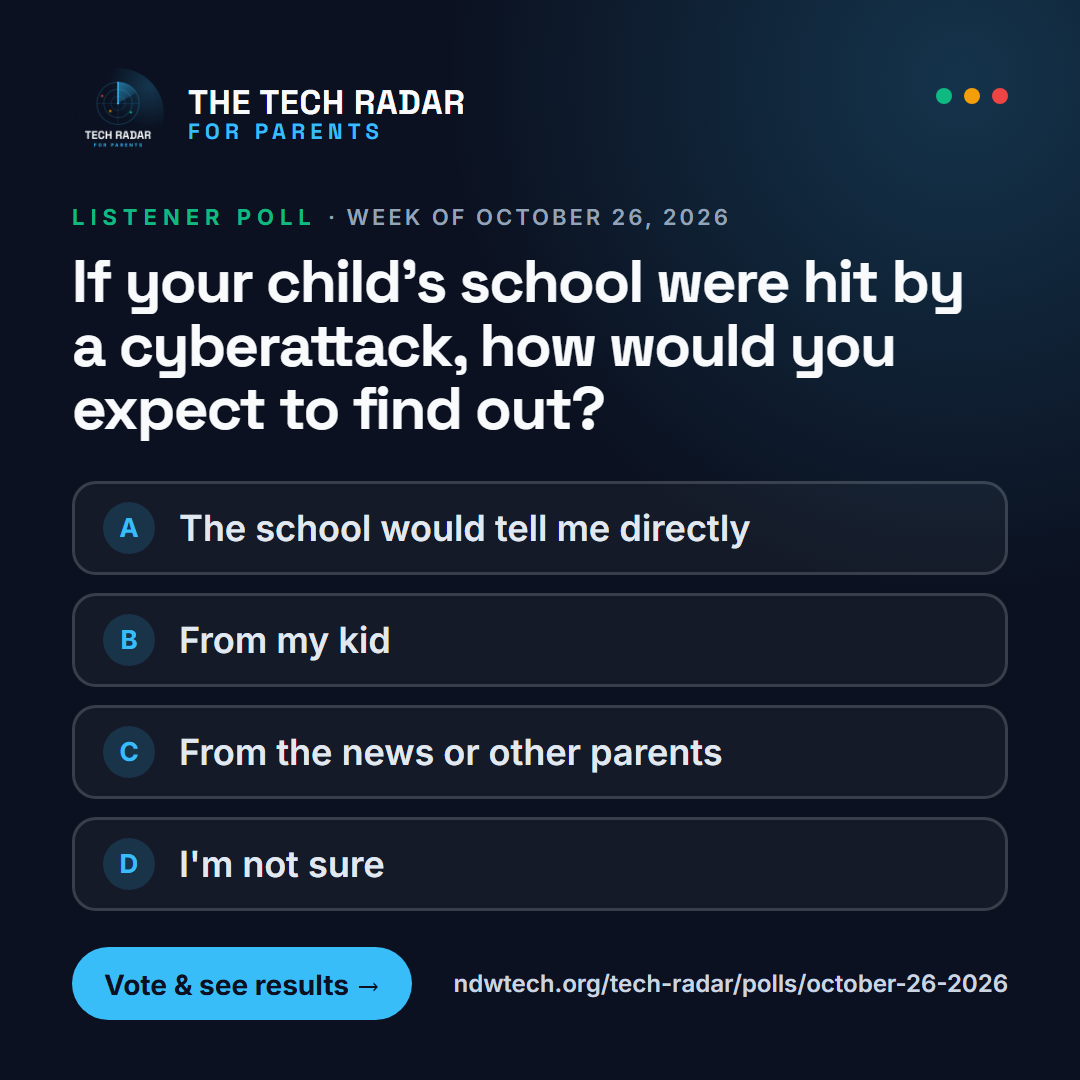
Listener poll
If your child's school were hit by a cyberattack, how would you expect to find out?
This week, Richmond, Virginia's 22,000-student school district spent the week offline after a ransom note appeared on teachers' laptops, and a district in Idaho closed for two days after hackers took over its cameras, door locks and heating. We want to know how parents expect to hear when it happens at their school.
Share this poll
Still on the radar
- Texas v. OpenAI (October 23): Attorney General Ken Paxton sued six OpenAI entities and CEO Sam Altman personally in Collin County, saying minors “have become addicted to a tool that fakes human compassion,” and asking a judge to bar ChatGPT for Texas minors and require a court-approved evaluator for new models. Separate from the eight-state suit of October 14. OpenAI says it is committed to working with the state. Allegations, nothing ruled.
- Frontline Education (October 26): the K-12 software vendor posted a public breach notice and began mailing affected people. A third-party flaw allowed access on August 14–15; exposed data varies by person and includes Social Security numbers, birth dates, government IDs and student IDs. No total count.
- Roblox: its quarterly report says the FTC, Pennsylvania and Utah notified the company in October that they are considering claims under COPPA and state consumer-protection laws. Considering, not filed.
- Character.AI's bankruptcy: by October 28, 39 states and D.C. opposed the bidding rules around Disney's $20 million lead bid; bids are due November 20 and the sale hearing is November 24. User data and chats stay with the estate.
- November 4: opening statements expected in the Los Angeles Meta/Snap trial.
- Not moving this week: Australia has still filed nothing against the five platforms; no ruling or Roblox response on Arizona's petition; no new development on the ETS/California breach.
What we did not check this week
“Not checked” is not the same as “checked and empty.”
- No court filings were pulled, in West Virginia, Los Angeles or Texas.
- Richmond's own website carried no notice we could find, so the details come from local reporters who were in the buildings.
- We found no response from TikTok to West Virginia's suit.
- Georgia's SB 351 and Florida's HB3 were not checked this week.