Parent Pulse: Weekly Radar
October 12 – October 17, 2026 | Digital Youth Culture & Safety Report
Eight states vs. ChatGPT. A week after a watchdog called ChatGPT for Teens unsafe, eight states took OpenAI to court. A federal appeals court let Florida keep its law barring social media accounts for kids under 14. And a report says the FTC is investigating Roblox, as a Florida family alleges predators found their 10-year-old there.
This report discusses suicide and child sexual exploitation. If you or your child are struggling, the 988 Suicide & Crisis Lifeline is free, confidential and available 24/7 — call or text 988. To report online exploitation of a child, use NCMEC's CyberTipline at report.cybertip.org.
🔖 A note on this week's sourcing
The HB3 ruling is from the release of CCIA, the industry group that lost, and CBS, both October 14. The OpenAI suits are from Reuters, CNBC and the Iowa and Kansas attorneys general, all October 14. Common Sense Media's rebuttal is its own October 13 post. The Roblox FTC report is from MLex (October 9), and the Orange County, Florida lawsuit is from WFTV (October 14).
Four precision notes. Florida's HB3 has been enforceable since November 2025; October 14 is the full ruling on the appeal, not a new start date. The FTC has not announced a Roblox investigation; we are relaying one paywalled report. The Roblox, Discord and OpenAI claims are allegations. And Common Sense's “no alert” finding applies to newly created parent-linked accounts: alerts did fire on older accounts. We left out a widely shared “2 alerts in 450 prompts” figure because other coverage of the same report gives different numbers.
Listen to this week
Episode published 2026-10-19 · 10 min
Eight States Sue OpenAI Over ChatGPT and Kids
Get this in your inbox every week
One email a week. The week's findings, sourced, in plain language. No spam, unsubscribe any time.
The good: Florida's social media law stands
U.S. Court of Appeals for the Eleventh Circuit · CCIA & NetChoice v. Uthmeier (No. 25-11881) · decided Wednesday, October 14, 2026
Florida's 2024 law, HB3, bars accounts for children under 14 on covered social media platforms and requires parental consent for 14- and 15-year-olds. Two industry groups, NetChoice and the Computer & Communications Industry Association (CCIA), sued on free-speech grounds and won a preliminary injunction blocking it. On October 14 the Eleventh Circuit reversed and vacated that injunction.
| What the court held | What it means for parents |
|---|---|
| HB3 is content-neutral | It regulates how kids get accounts, not which ideas can be said, so it faces a lower bar (intermediate scrutiny). |
| Florida has an important interest | Protecting minors from social-media addiction and harm counts as a legitimate reason to regulate. |
| The law doesn't burden substantially more speech than necessary | The court rejected the claim that the law sweeps too broadly. |
Timing: HB3 has been enforceable since November 2025, when the same court stayed the injunction. Arguments on the appeal were heard March 9, 2026. October 14 is the full decision.
The ruling “is deeply concerning” and “risks imposing identity authentication on Floridian internet users of all ages.” — Matt Schruers, President & CEO, CCIA
Why it's the good news — with a tradeoff. A federal appeals court has now said a state can keep young kids off social media, and every state writing its own version just got a road map. The cost is real: proving a child is under 14 usually means checking everyone's age. The fight may not be over.
The bad: Roblox, under a microscope
MLex report, Friday, October 9, 2026 · lawsuit filed Wednesday, October 14, 2026 · report and allegations, not findings
A reported FTC investigation. The legal news service MLex reported on October 9 that the Federal Trade Commission is examining whether Roblox's platform design let predators find child victims, in a “long-running probe” that “is likely to reach a conclusion before the end of the year.” The FTC has not announced an investigation, and MLex's report is paywalled; treat it as a report, not a finding.
A Florida family sues. On October 14, a family in Orange County, Florida sued Roblox and Discord. They allege the platforms let adult predators pose as minors, and that five adults targeted their 10-year-old daughter, coerced her into sending sexually explicit material, and abused her. These are allegations; nothing has been proven in court.
Roblox declined to comment on the suit. It said it was the first online gaming platform to require age checks for all users who want to start a chat group. Discord's response was not reported.
The pattern: a game where kids play, a chat where an adult pretends to be a kid, then a move to a second app where nobody is watching. The game is the front door. The danger is the chat.
The ugly: eight states sue OpenAI
Eight state courts · filed Wednesday, October 14, 2026 · allegations, not findings
Iowa, Kansas, Nebraska, West Virginia, Arkansas, Arizona, Idaho and Montana each sued OpenAI in their own state courts, according to Iowa Attorney General Brenna Bird. Florida brought the first state suit against OpenAI in June.
- The allegations: OpenAI marketed ChatGPT as safe for teenagers while it encouraged suicide, reinforced delusions and gave harmful medical advice, and was designed to imitate emotions and flatter users. Kansas's petition runs 72 pages under the Kansas Consumer Protection Act; Iowa sued under its Consumer Fraud Act.
- What the states want: a court order changing how ChatGPT works for children, and an order making OpenAI give up profits it made from young users (Reuters).
“OpenAI claims ChatGPT is safe while it's giving dangerous medical advice, encouraging people to hurt others, and coaching people to commit suicide — all while pretending to be their fake friend.” — Iowa Attorney General Brenna Bird
“While no system can be perfect, we'll continue to work with experts to inform our work and build additional safeguards, such as the parental controls, break reminders and age-appropriate model protections that exist today.” — Drew Pusateri, OpenAI spokesperson
Follow-up: Common Sense stands by its ChatGPT for Teens testing
On October 13, Common Sense Media's Youth AI Safety Institute answered OpenAI's claim that its tests began before parental controls switched on: “That's not what happened.” It says it confirmed with OpenAI beforehand that Teen mode was live; on newly created accounts linked to a parent before the first message, up to an hour of conversation about suicide, self-harm or eating disorders produced no alert, including on some accounts linked for more than three hours. Alerts did arrive on older accounts with weeks of history. OpenAI says linking can take several hours and that, once linked, it aims to alert parents in under an hour. Common Sense will retest after OpenAI reports improvements. (NPR notes the Institute is partly funded by the OpenAI Foundation.)
Why it's the ugly: these are lawsuits, and nothing is proven. But this is no longer one watchdog's report. It is nine states making the same case in court.
The Decoder Ring: decoding the headlines
We looked again for new slang with a real date and a credible source behind it and came up empty. Here are the words from this week's headlines instead.
| Term | What a parent needs |
|---|---|
| Content-neutral | A law about how something happens (who can open an account) rather than which ideas can be said. Courts go easier on these — a big reason HB3 survived. |
| Preliminary injunction | A judge's order pausing a law, or forcing a change, while the case continues. HB3 was under one. Now it isn't. |
| Disgorgement | A court making a company hand over profits it got from wrongdoing. The states want something like it from OpenAI. |
| Sycophancy | A chatbot telling you what you want to hear — constant flattery and agreement. The states argue it keeps kids hooked. |
Your action plan this week
1. Lock down who can talk to your kid in games.
In Roblox, link your own parent account under Parental Controls, then set who can chat with your child — or turn chat off for younger kids. On Discord, Family Center shows who your teen is talking to. Ten minutes, side by side, this week.
2. Teach the move rule.
If anyone online asks to switch to another app, asks for a picture, or asks to keep a secret, that's the moment to tell you. Say out loud that they won't lose their games or their phone for telling you. Kids stay quiet when they think they'll be punished.
3. Treat chatbot alerts as a backup.
If you've linked a parent account to your teen's ChatGPT, good — but testing says alerts can lag, especially on new accounts. Ask what they use it for, and say it plainly: if things ever get really hard, come to me, not the chatbot.
4. Check the birthday on every account.
Age laws like Florida's, and every app's teen protections, only work if the app knows your child's real age. Open their apps together and look at the birth year. If it's wrong, fix it.
Listener poll · closed
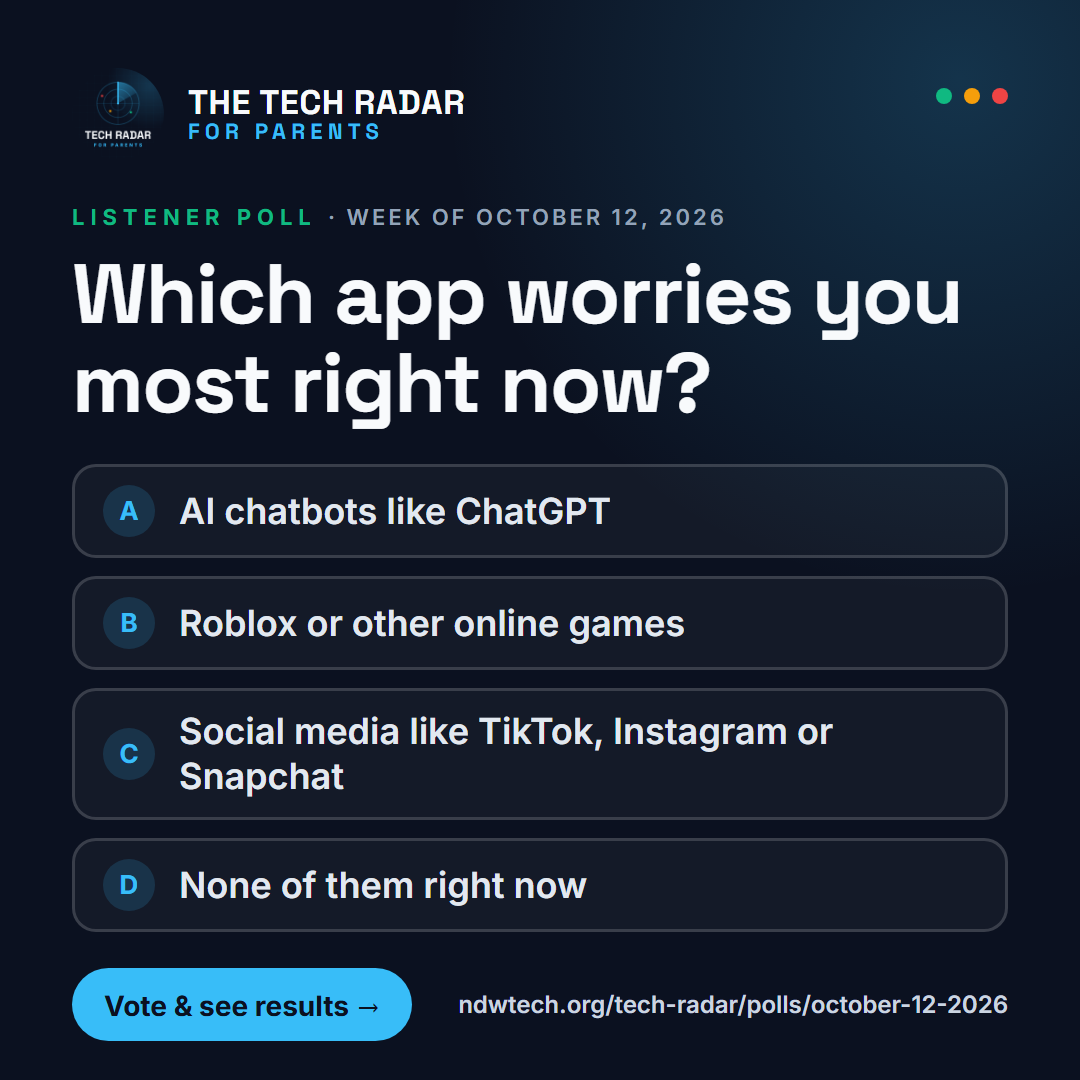
Which app worries you most right now?
This week, eight states sued OpenAI over ChatGPT and kids, a report said the FTC is investigating Roblox, and a federal appeals court let Florida's under-14 social media law stand. We want to know which one is on your mind at home.
Share this poll
Still on the radar
- New Mexico v. Meta: the judge is still expected to rule this month on the state's $35–40 billion penalty request; MLex reports collection of the earlier judgment is stayed. No ruling found as of October 14.
- October 28: the Los Angeles bellwether trial against Meta, YouTube and Snap remains on the calendar.
- Florida v. Meta: no hearing or ruling found on the October 7 injunction motion.
- NetChoice v. California: MLex reports an amended complaint (October 14) arguing Section 230 preempts a California social media law; the statute isn't named in the accessible text.
- Pressure on TikTok, YouTube and Snapchat: the American Principles Project and allied groups (October 13) asked the three to adopt Meta-settlement-style limits voluntarily. No company responses reported.
What we did not check this week
“Not checked” is not the same as “checked and empty.”
- No court dockets were pulled for any case, including the eight OpenAI petitions and the Orange County suit.
- The FTC report rests on one paywalled source; we could not read Roblox's response in it.
- TikTok, Snapchat and Instagram product changes got only a quick search.