Parent Pulse: Weekly Radar
November 2 – November 7, 2026 | Digital Youth Culture & Safety Report
A warning light, a lawsuit and a breach. Meta began rolling out alerts that tell supervising parents when a teen keeps searching for suicide or self-harm, or says something worrying to Meta's chatbot. West Virginia sued Snap over a 15-year-old's sextortion death. And a school software breach grew past a million people.
This report discusses suicide and sextortion. If you or your child are struggling, the 988 Suicide & Crisis Lifeline is free, confidential and available 24/7 — call or text 988. If someone is threatening your child with images, report it to the FBI at tips.fbi.gov.
🔖 A note on this week's sourcing
Meta's alerts come from Dataconomy (October 30), TNGlobal and KWCH (November 2) and Scripps News; Meta updated existing newsroom posts rather than publishing a new dated one. West Virginia v. Snap comes from WV MetroNews and West Virginia Public Broadcasting (November 5), the Washington Times, WOWK and MLex; we did not read the complaint. The Los Angeles settlement comes from NBC News/Reuters (November 2). Frontline's count comes from SecurityWeek (November 3), which summed five states' attorney-general filings. This week's research was done by hand search and fetched reporting; our usual automated second research pass did not run.
Four precision notes. Meta's alerts reach only parents with supervision turned on, and Meta has published no accuracy or false-alarm numbers. West Virginia's filing is a lawsuit: allegations, with no Snap response found. The Los Angeles case settled; no jury decided anything. And Frontline's 1,298,917 is five states' filings only; what was exposed varies by person.
Listen to this week
Episode published 2026-11-09 · 11 min
Meta Will Now Alert Parents When a Teen Searches for Self-Harm
Get this in your inbox every week
One email a week. The week's findings, sourced, in plain language. No spam, unsubscribe any time.
The good: a warning light for parents
Meta · rolling out globally to supervising parents · coverage October 30 – November 2, 2026 · only with supervision on
Until now, Meta's parent alerts covered Instagram searches only. This week the company began extending them to Facebook, and to conversations with Meta AI on Facebook, Instagram and Messenger.
| What triggers an alert | What the parent gets |
|---|---|
| A teen repeatedly searches for suicide or self-harm terms “within a short period of time” on Facebook (new) or Instagram. Meta has not published the exact threshold. | A text, email, WhatsApp message or in-app notice. It leaves out the search terms and the chat, and points to expert guidance on starting the conversation and to helplines. |
| A teen's conversation with Meta AI suggests they may be at risk of suicide or self-harm. Meta says a person reviews every flagged chat before an alert goes out. |
“It's vital that parents have the information they need to support their teens.” — Vicki Shotbolt, CEO of Parent Zone (Scripps News)
The caveat: it only reaches parents who have supervision turned on, which you and your teen set up together. Meta has published no accuracy, miss or false-alarm rates, and nobody outside the company has tested it. A teen on a second, unsupervised account or a different app is not covered. Meta says a feature to contact emergency services in imminent-risk chats is still being built.
Why it's the good news: for years, most parents found out a child was in that dark place after the fact. This is a signal before. It won't catch everything, and it doesn't replace you. But a warning light only helps if it's plugged in.
The bad: West Virginia sues Snap
State of West Virginia v. Snap Inc. · Kanawha County Circuit Court · filed Thursday, November 5, 2026 · allegations, not findings
Attorney General JB McCuskey built the case around Bryce Tate, a 15-year-old sophomore at Nitro High School who died last November. The state says someone on Snapchat posing as “a 17-year-old girl who knew him” got him to send images, then demanded $500; Bryce offered $30; the predator sent about 120 messages in 20 minutes. His father says it was three hours from the first message to his son's death. The suit was filed a day before the anniversary, one week after the state sued TikTok.
- Safety claims: the state alleges Snap marketed Snapchat as safe while a June 2022 internal review acknowledged grooming was prominent; that 96.7% of reported accounts did not lead to review; and that 86.3% of flagged sexual content expired before review.
- Design: disappearing messages that erase evidence; Streaks, Snapscores and endless feeds employees called “accidentally addictive”; a Family Center that gives parents “visibility but not control.”
- My AI: released to all users including minors on April 19, 2023. The complaint alleges it could see a child's location even with Ghost Mode on, and that kids' chats went to OpenAI and conversation content to Microsoft Advertising.
- The ask: a permanent injunction, civil penalties and court-ordered safety changes.
“This sextortion plot began on Snapchat – and we will hold the company accountable for this tragedy.” — West Virginia Attorney General JB McCuskey
This is a lawsuit filed Thursday. These are allegations, nothing has been proven, and we found no response from Snap. Alongside it, the state and the Bryce Tate Memorial Foundation launched the Shield Initiative, whose message to kids is “Stop. Screenshot. Show Someone.”
Meanwhile in Los Angeles: no trial
On Monday, November 2, Snap settled with the last two plaintiffs in the city's second social media addiction bellwether, S.J., 16, of Illinois and K.D.B., 18, of Mississippi, during jury selection and two days before opening statements. Meta, TikTok and YouTube had already settled with them. The terms are confidential, Snap's chief executive will not testify, and the next trials there are set for March, according to the plaintiffs' lawyers. (Last week we reported openings were expected November 4; that was the schedule at the time.)
Why it matters at home: sextortion runs on panic and shame, and it moves in minutes. Teach the three words, and promise your kid they will not be in trouble with you.
The ugly: the Frontline breach keeps growing
Frontline Education · intrusion August 14, 2026 · public notice October 26 · 1,298,917 people in five states' filings (SecurityWeek, November 3)
Frontline makes software that school districts use for staff records (Frontline Central) and student health records (School Health Management), the kind a school nurse keeps. SecurityWeek added up the notices Frontline filed with the attorneys general of Massachusetts, New Hampshire, South Carolina, Texas and Vermont. Frontline also filed in California, Indiana and Iowa, so the total is almost certainly higher. A report a week earlier put it at 800,000.
| What may be included (varies by person) | What nobody knows yet |
|---|---|
| Names, Social Security numbers, dates of birth | The full total. Frontline has not given one, and not every person had every field exposed. How many school districts used the two products is not public. No ransomware group has claimed the attack. |
| Driver's license, passport and other government ID numbers | |
| Health insurance information such as Medicaid IDs; student IDs |
- How: a flaw in another company's software; Frontline says it was “fully contained by August 15.”
- Notice: districts first, then individuals by email or mailed letter. Offer: two years of credit monitoring for adults; dark-web monitoring for qualified minors.
- Richmond, Virginia (last week's ugly): as of October 31 the FBI and Virginia State Police were helping, the district had a temporary network and handed out Chromebooks, and it still had not said whether personal information was affected. No group has claimed the attack.
Why it's the ugly: you never signed up for Frontline. Your school did. And a letter in the mail may be the first you hear of it.
The Decoder Ring: mogging, word of the year
On November 3, Collins Dictionary named “mogging” its 2026 Word of the Year. We decoded it at the end of September. Newly official, not new. Definitions below are paraphrased from coverage; we did not read Collins' own entries.
| Term | What a parent needs |
|---|---|
| Mogging | Roughly, to outshine someone; online it usually means looking better than them. Collins says usage rose 210% this year. |
| Mog / AMOG | The root: “alpha male of the group,” from bodybuilding forums and the manosphere. Most kids use it as a joke now. That history is why it's worth a question. |
| Lifemogging | Living a more impressive life than everyone around you. Also stylemogging and carmogging. |
| Friendslop | On the shortlist: a low-budget, independent video game played among friends. |
| P(doom) | On the shortlist: an estimate of the odds that AI causes the collapse of civilization. If your teen has a number, ask why. |
Your action plan this week
1. Plug in the warning light.
If your teen uses Instagram or Facebook, open Meta's Family Center together and set up supervision. Then check that the phone number and email on your account are current, because that's where an alert would go.
2. Teach West Virginia's three words.
Stop. Screenshot. Show someone. Then tell your kid, out loud, that if anyone ever threatens them with a photo, they will not be in trouble with you. Report sextortion to the FBI at tips.fbi.gov.
3. Look at My AI together.
Open Snapchat with your teen. Ask what they use My AI for, and what they've told it. Check Ghost Mode and Snapchat's Family Center, and remember, the state alleges the chatbot may see more than the map shows.
4. Ask your school one question.
Did we use Frontline Central or School Health Management? If yes, watch for a letter, sign your child up for the free monitoring, and consider freezing your child's credit. It's free, and it stops anyone from opening accounts in their name.
Listener poll
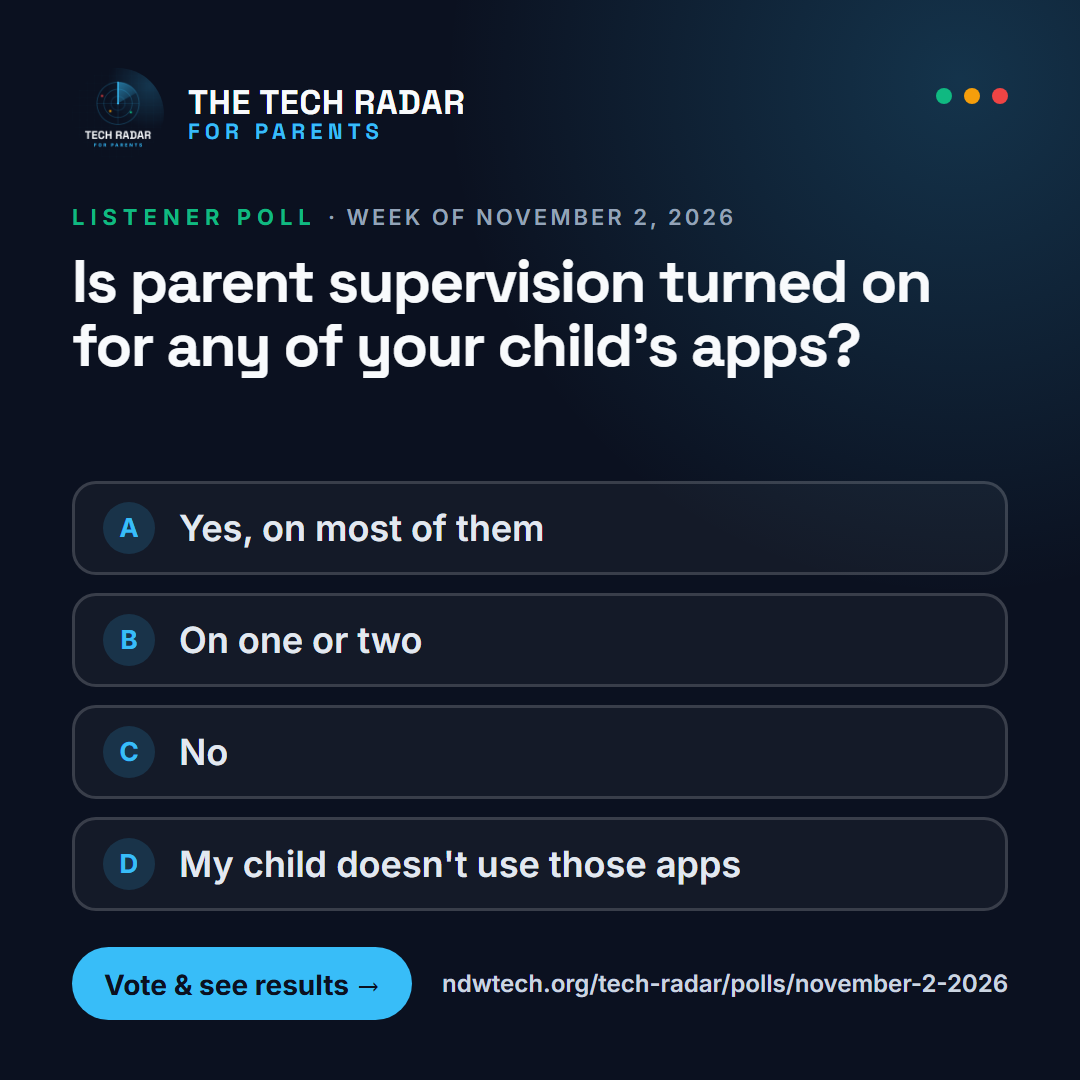
Is parent supervision turned on for any of your child's apps?
This week, Meta began rolling out alerts that tell parents when a teen repeatedly searches for suicide or self-harm, or says something worrying to Meta's chatbot. The alerts only reach parents who have supervision turned on. We want to know how many parents have it set up at home.
Share this poll
Still on the radar
- California AB 1709 (November 5): Meta, Google and TikTok each sued Attorney General Rob Bonta to stop the law that bars autoplay and personalized feeds for under-16s from January 1, 2027, arguing the First Amendment and Section 230. Bonta's office says it will defend the law. Filed, not ruled.
- Character.AI's bankruptcy: at an October 30 hearing the court signaled it would overrule objections from about 40 states, D.C. and the US Trustee to the sale rules; the proposed order has no consumer-privacy ombudsman. Bids are now due November 24, the auction is December 1 and the sale hearing December 3–4.
- Texas v. OpenAI (filed October 23): no ruling or response found this week. Allegations, nothing ruled.
- Roblox: the FTC, Pennsylvania and Utah are still only considering claims; nothing filed that we found. No ruling on Arizona's October petition to compel Roblox documents.
- Florida and Georgia: appeals courts lifted injunctions on both states' teen social media laws in mid-October (Florida's HB3 on October 14; Georgia's on October 21 reporting).
- Not moving this week: Australia, the ETS/California breach, and the eight-state suits against OpenAI.
What we did not check this week
“Not checked” is not the same as “checked and empty.”
- We did not read the West Virginia complaint, the three California complaints, or Frontline's state filings ourselves.
- Meta has published no accuracy numbers for its alerts, and we found no independent test.
- We found no response from Snap to West Virginia's suit.
- Our automated second research pass did not run this week; everything here comes from hand searches and fetched reporting.